New Zealand
Ads
Ads

About New Zealand

New Zealand Tech Edge
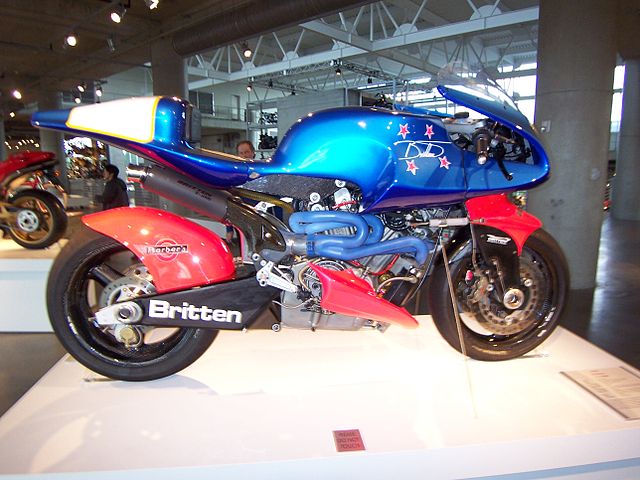
Britten racing motorcycle

   
New Zealand has an exciting technological edge in the sporting world regarding the use of carbon fiber.  Starting in the early 1990's New Zealand has pioneered the daring use if this space-age material for racing motorcycles, the 2000 series of the Americas Cup Yacht races which she won handily and most recently the world record setting round the world powered boat on the least fuel, the Earthrace boat.

If you have any interest in world class racing motorcycles but have wondered what kind of country, what environment, what schooling system, what kind of culture would dare breed such avant guard thinking-- look no further, it is New Zealand.
Most people of the non racing world have never heard about the Britten motorcycle but this racing-mad country has all but enshrined John Britten as one of its pre-eminent inventors and one of its greatest legends.

As has been said time and again by so may experts and commentators, the self reliant can-do attitude that New Zealanders have had to develop was in no small part a  direct result of being so severely isolated from the nearest re-supply which was often 20,000 Kilometers away in Europe. If you visit this country you will become aware of its penchant for making do with less and making things work on a proverbial shoe string. Taking a totally whole new approach to problems and coming up with radical, unprecedented solutions are what has not only characterized Brittens Bikes - eventually 10 were produced- but arguably is a hallmark of this nation.
This is what John Britten and literally a few friends did in designing and building his V 1000 racing motorcycle. It not only took the sporting world by storm, it shattered it! It has been described as the greatest motorcycle ever built and it set four motorcycle world speed records: the standing ¼ mile, the mile  and kilometre and the flying mile at 302 kph. It went on to win the Battle of the Twins in the Netherlands in 1992 and Daytona and did so repeatedly in that even and the BEARS - British European American Racing - events in the latter 90's. Huge factory teams and resources fielded by Honda and Ducati were of no use against the tiny crew and enterprise of the Britten contingent as they all succumbed to the ferocious speed, lightweight and revolutionary technology that liberally adorned the Britten.  Aerodynamic charge induction, and consequently small radiator location, lightweight semi-intelligent front girder-type suspension,  frame-less design and construction, various parts of this winning recipe have now been adopted by the worlds competitors whom back then did not realize what they were looking at and falling victim to at the many races across the world.
 Built almost entirely of carbon fiber including the wheels, even the motor itself was an entirely radical, brand new and unique creation which Britten hand cast in aluminium himself.

Sadly, New Zealand and the motorcycling world lost a great visionary and revolutionary designer when John Britten succumbed to melanoma in 1995.


Earthrace Boat

A revolutionary 78-foot (24m) wave piercing trimaran originally named Earthrace,  broke the world record for circumnavigating the globe in a powerboat on June 27, 2008. It set the record at 60 days, 23 hours , 49 minutes. It destroyed the existing world record set by the Cable and Wireless Adventurer ( originally named at that time Ocean 7 Adventurer )  by a humbling  13 days, 21 hours, 9 minutes.
Again it has shown that New Zealand has not only eclipsed and startled the worlds best,  but has highlighted this nations penchant for dramatic, daring approaches in unorthodox design.

Carbon fiber and bold use there-of has become  iconic in New Zealand ventures into motorcycle racing on the international circuits, 12 metre yacht racing and now long distance record setting for a powered boat.  In all of these New zealand has proven an exciting world leader and paradoxically the quiet home to daring innovators.

The Earthrace boat ( the latest iteration being named  Ady Gil after the California millionaire sponsor )
 was designed specifically to break the worlds record for circumnavigating the globe in a powerboat while highlighting the eco-friendly, most carbon neutral regime possible.
It was of  revolutionary design in a very fundamental sense:  it was computer aided in design concept and predicted to 'cut through' the waves rather than wasting energy going over the top of them. Fully submersible, she could cut through 15 metre ( 49 foot ) waves and go a full 7 m ( 23 feet ) underwater.
In the event,   the predictions have been proven correct and much energy was indeed saved in the relatively more even keeled plane of motion.
As per Kiwi ( New Zealanders )  habit and preference,  Earthrace was 100% carbon fiber in her hull construction. The cost at around $2.5 million is not at all surprising even for a boat not quite 80 feet.
Powered by two 540 Cummins Mercruiser Engines, she ran on an animal fat and vegetable oil mix bio diesel. It could just as easily have run on conventional diesel, bio-diesel or blends.
The air intakes were on two startling fins raked at such an angle and curve that the entire package and end effect evoked an appearance of some  some gigantic unknown biological life-form.
While the two propellers were mounted under the main hull,  the rudders were located out in the pontoons.  This arrangement proved good in the turns at speed but at slower regimes in the neighborhood of 12 knots, it had limited maneuverability.
Nonetheless in the long distances which she was designed for,  this was perfectly in keeping for a craft whose bread and butter so to speak was chewing through long stretches of sea and waves for thousands upon thousands of kilometers.

As a showcase and standard bearer for the green movement and ecological concerns at the forefront today,  it is hardly surprising its crew became involved in the anti-whaling controversy.

Japan has frequently been at odds with various groups whom view continued whaling predation in this day and age as blatant endangerment of the earths precious resources. New Zealand waters and in particular the great Southern Ocean down towards Antarctica are some of the richest remaining habitats of certain whale species.

As the renamed  Ady Gil, the boat became involved in dangerous confrontations with Japanese whaling ships in January 6, 2010.   In a resulting collision attempting to ward off  a Japanese whaler, the Ady Gil  was severely damaged and eventually sunk.